As Tucker Carlson recently pointed out, “there is zero appetite for [American boots on the ground in Iran]... It would take some sort of terror attack in the United States, probably like 9/11, for us to do that.” Tucker is right in this assessment. According to recent polling, 74% of voters oppose boots on the ground in Iran. However, if a terror attack were to happen, it is very likely that a significant portion of Americans would experience the “rally 'round the flag effect.” This phenomenon occurs when a leader receives a short-term surge in approval during a time of national crisis. For example, after the 9/11 attacks, President George W. Bush's approval jumped from 51% to 86%. A major component of the diversionary theory of war, this effect is often used by those in power to distract from domestic struggles.
As I explained in a previous article, President Donald Trump once claimed that Barack Obama would start a war with Iran to divert public attention from domestic failures. But with the Trump administration receiving strong bipartisan criticism for its handling of the Epstein files, immigration, and the affordability crisis, Trump, has embroiled the US in a war with Iran for the second time in under a year.
With President Trump’s approval rating hitting new second-term lows on immigration and the economy, Trump would significantly benefit from the rally 'round the flag effect, especially if he is committed to Iran’s unconditional surrender. During the Second World War, it took invasions, occupation, and, in Japan’s case, nuclear weapons, to get the Axis Powers to agree to such terms. A currently unpopular ground invasion would almost certainly be necessary for unconditional surrender. Despite this, a ground invasion could become at least temporarily popular if Iran attempted to carry out drone strikes on American soil as rumored in a recent FBI memo.
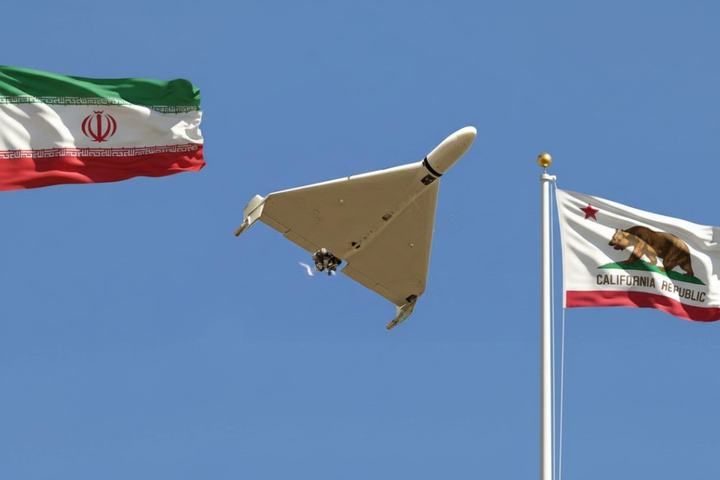
According to Reuters, which obtained an undated, unclassified copy of the security bulletin, the FBI claims that Iran "allegedly aspired to conduct a surprise attack using unmanned aerial vehicles" in early February. This attack was planned "in the event that the US conducted strikes against Iran." The FBI states that Iran planned to launch drones from a sea vessel to hit targets in California, though no specific targets were mentioned. Governor Gavin Newsom has denied that any imminent threat to California exists while also adding that "We've been aware of that information... It's all about a posture of preparedness for worst-case scenarios.”
On March 11, Trump remarked that “It's being investigated,” but, a day later White House Press Secretary, Karoline Leavitt, announced that the memo was merely “one email that was sent to local law enforcement in California about a single, unverified tip,” adding that, “no such threat from Iran to our homeland exists, and it never did.” She also called on ABC News to retract its original report regarding the memo, calling it “false information to intentionally alarm the American people.” However, The Sacramento Bee reported that the FBI’s Sacramento field office said that the agency “will neither confirm nor deny” ABC’s report. The real question is: could Iran actually attack California and, if not, what incentives would there be in spreading this story?
Jeff Thompson, CEO of Red Cat, a company which develops military-grade drones, stated that “if [Iran is] trying to launch vertical-launch mechanisms off of small boats off the coast of California, it's going to be very easy to find and very easy to kill." Nevertheless, he also made it clear that “The really small ones like FPV drones... are going to be very hard to battle because they're just so quick.” While Iran’s drones have proven to be deadly on the Ukrainian battlefield, Iranian drones like the Shahed-136 only have a range of about 1,000-2,000 km. This is why, in a hypothetical scenario, Iran would need to transfer them by boat. The likelihood that a carrier boat wouldn’t be detected en route to the US is extremely low. It would likely take weeks for the boat to arrive and pass through heavily monitored maritime routes. Even if the vessel somehow avoided detection at sea, American or Israeli intelligence could potentially uncover the plot before it got close enough to be dangerous.
If it is unlikely that Iran could pose a threat to California, why are we hearing about this story in the first place? Well, it is no secret that the media profits from sensationalism. Websites generate revenue from clicks and social media sites algorithmically favor content that promotes emotion and, subsequently, engagement. Fear of an impending Iranian attack could easily garner the attention of the public. Indeed, I first learned of this topic after my friend showed me a viral Instagram post. Yet media incentives might not fully explain why this poorly-sourced story circulated in the first place. There could be a much more sinister reason behind why this story is showing up in our feeds.
Sometimes, the best way to trigger the rally 'round the flag effect is to manufacture a national crisis yourself. A false flag incident is an act that is carried out for the express purpose of blaming it on another party. For example, Operation Northwoods was a false flag operation planned by the American government, but ultimately rejected by President John F. Kennedy. The plan was to blame acts of terrorism on the Cuban government. In reality, the CIA would stage and carry out these acts against both military and civilian targets. Two years later, after the assassination of President Kennedy, his successor carried out a similarly dubious plot that led to the loss of thousands of American lives in the Vietnam War.
The closest verified example to a false flag involving the US is the Gulf of Tonkin incident. On August 2, 1964, the USS Maddox engaged in a firefight with three North Vietnamese torpedo boats. The USS Maddox was unharmed, but one of the North Vietnamese torpedo boats was damaged. On August 4, 1964, the US intercepted North Vietnamese communications regarding the incident on the 2nd, but interpreted it as a separate, more deadly attack. President Lyndon Johnson announced the attack publicly, and Congress passed the Gulf of Tonkin Resolution, which led to the direct involvement of the US in Vietnam. In 1965, Lyndon Johnson admitted, “For all I know, our Navy was shooting at whales out there.”
If the Trump administration wanted to justify a ground invasion of Iran or reinstate the draft to send young American men to die on behalf of Israel, distorted or fabricated intelligence about an Iranian attack could be a perfect pretext. History has shown that Machiavellian political actors can use ambiguity and poor verification to make unpopular military action popular. Regardless of whether the Iranian drone threat is real, a result of media amplification, or something else entirely, Americans should demand the utmost transparency before accepting claims that could escalate the already costly Iran war.
No comments yet. Be the first.