

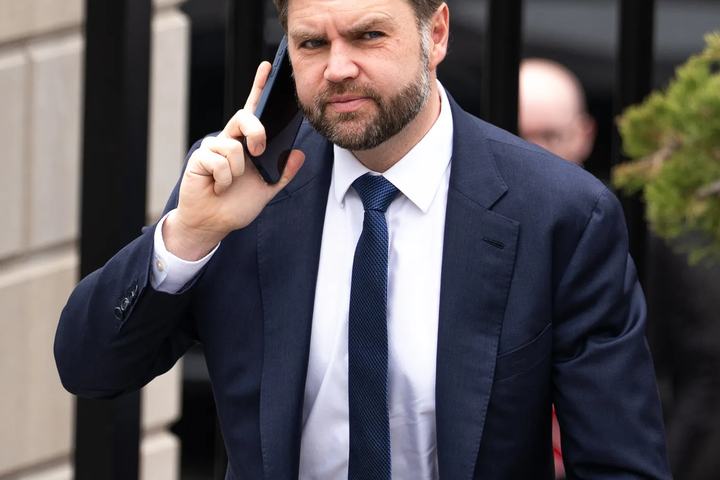
Since the outbreak of the war in Iran, Vance’s numerous soundbites assuring American voters that a ballot cast for Trump is a ballot cast in favor of peace and against endless wars on the campaign trail have come back to haunt him. In the wake of the operation late last month, the New York Times published a story noting that Vance swayed Trump to support a larger strike on Iranian soil. Prior to Vance’s input, he was reportedly leaning towards a more restrained approach. Vance told the President that if he was to strike Iran he should “go big and go fast.”
Anonymous White House sources quickly emerged to blunt the fallout, painting Vance as a lone advocate of non-interventionism in an otherwise hawkish administration. It is dubious as to whether this is true, as Vance’s public record on the specific issue of striking Iran has been especially mixed.
Vance, shortly after being selected as Vice President at the 2024 RNC, inveighed against “weak little bombing runs” in favor of a larger attack on Iran. But on Tim Dillon’s podcast, 3 months later, Vance said that a war with Iran would not be in the interest of the US.
If we take Vance at the word of his associates, we are to believe that he personally cautioned against strikes, but argued that strikes ought to be decisive should they occur at all. So they say, Vance is totally opposed to war, but isn’t at liberty to say so.
This assertion is complicated by the fact that Vice President Vance exhorted Trump to take an aggressive approach against Iran in the early weeks of 2026. On January 16-17, JD reportedly counseled the President to enforce the “red line” he had drawn concerning the execution of anti-regime protestors. He insisted that a refusal to carry out an attack would abrade American credibility on the global stage. Funnily enough, Trump backed down, only to launch an attack with Netanyahu in the subsequent month.
Despite abstruse allusions to skepticism over foreign interventions, it’s unclear where Vance stands politically. Unlike Trump, Vance still hopes to reframe the administration’s actions as a one-off still contiguous with the White House’s campaign promises. It was only last June that Vance assured supporters that this time would be different and plummeting bunker busters bombs on Fordow and Isfahan would not eventually culminate in another interminable “forever war.” The difference between then and now, Vance maintained, was that the chief occupant of the Oval Office was no longer a “dumb” person. Another eye-watering assertion saw Vance argue that America wasn’t at war with Iran, just Iran’s nuclear program.
The stark difference between then and now is that Trump, while no more averse to nation building ventures than his predecessors, lacks the strategic acumen of prior administrations. Bush, while not a particularly brilliant man, had competent, if cruel, advisers like Cheney, Powell, Rumsfeld, and Wolfowitz to counsel him. The Iraq war, for all its failures, was pitched to Americans under the oft-repeated lie of WMDs. After months of internal deliberation, W. Bush made his case, in 2002, at the UN, and then in 2003 at the State of the Union for ousting Saddam.
In contrast, Trump’s latest State of the Union speech only mentioned Iran in passing. Plans to strike Iran in concert with Israel emerged only haphazardly, and objectives are still unclear. Vance stated that the war was waged to prevent Iran from securing nuclear weapons, while Trump has oscillated between regime change and disarmament. The Department of War hasn’t made a case either. This may be owed to the fact that Hegseth is more interested in performing slam poetry about maximum lethality than devising a decent casus belli for gullible Americans. John Bolton, the quintessential neocon, has even expressed reservations over Trump’s current siege of Iran—not because he opposes strikes, but rather the way in which Trump is carrying them out.
The intervention is turning out to be an unforeseen disaster for the White House. Trump, fresh off the heels of Maduro’s ouster in Venezuela, which successfully won America control over the nation’s oil reserves, thought he would try the same thing in Iran. When Joint Chiefs of Staff Dan Caine cautioned the President that a strike on Iran could ensue in the closure of the Strait of Hormuz, skyrocketing gas prices and energy costs, the President brushed this off as unlikely.
A mere 2 weeks into the war, Iran has frozen traffic in the strait using mines, missiles, and drones and dealt numerous strikes to neighboring Gulf states’ oil infrastructure. As crude prices top $100 per barrel, Trump is frantically urging allies to deploy warships to re-open the strait. Bracketing the economic ramifications, the clean operation that Trump envisioned has not come to fruition, and the unfolding operation, unlike the swift extradition of Maduro, has begun to stack American corpses. 13 US service members have died in the region since the war began, and about 200 have been injured.
As the Pentagon sends 5,000 marines to the Middle East and speculation swirls over the possibility of a ground invasion, Vance’s guarantee that there’s “no chance” the US will be pulled into a long-term conflict looks more and more like damage control. A recent skeptic of old conflicts (Iraq, Afghanistan, Libya, and Syria), Vance is best poised to sell the base on the current one. Since last June, he has assured voters that this “conflict” will be the exception to years of failure.
Effusive regret cannot bring back the forty thousand Americans lost to suicide and combat injuries nor recoup the $8 trillion burned in the first two decades of the twenty-first century due to needless war. It only matters to oppose costly foreign entanglement as they emerge, not after they have played out disastrously.
In 2005, Vance was himself deployed to Iraq as a combat correspondent who saw little if any combat. As a bright-eyed, 20-year-old marine, Vance was initially optimistic about the war. In a 2010 article for Bush speechwriter David Frum’s “FrumForum,” he wrote that he supported the Iraq invasion on its “merits.” By 2016, Vance had begun to sing a different tune, attributing Trump’s rise on GOP pigheadedness in running “candidates who refused to rethink the Bush foreign policy that led to Iraq.” Shortly after winning his Ohio Senate race in 2020, Vance said that he had made the “mistake of supporting the Iraq War.” Then-Senator Vance explained his epiphany, “I saw when I went to Iraq that I had been lied to.”
Having practically run on Trump’s 2016 campaign manifesto concerning foreign conflict, Vance finds himself in an awkward position, left in the dust by a truly schizophrenic policy doctrine able to disintegrate and reconstitute at the caprice of a single man. President Trump leaked that Vance harbored some “philosophical” differences on the intervention, but ultimately “was quite enthusiastic.” Vance is surely aware of the fact that the war poses a threat to the political identity he has built for himself, and accordingly finds himself in a double-bind.
As the chosen heir to ‘MAGA,’ Vance can publicly break ranks with Trump on the war and risk accusations of disloyalty from a party still largely captured by his cult of personality, or he can remain silent, and go down with the proverbial ship. Vance is wedged between his public persona, his stated testimony as an Iraq war veteran, and the stated aims of the administration he hitched his wagon to, presumably in the hopes of a shot at the 2028 presidential nomination. Trump may turn out to be more of a millstone than a lifeline for Vance.
Optically, it doesn’t make sense for Vance, having long faced accusations of hypocrisy for his abrupt conversion to MAGA after voting for Evan McMullin in 2016 and bashing Trump as a “failure” in text messages as late as 2020, to support the war in Iran. Vance, careerist or not, has two options. He can voice his discomfort, which he has hitherto declined to do by telling reporters that his advice to the President on the Iran war is “classified,” or go along with the ride and pray for the best. Silence and personal endorsement are indistinguishable in the latter option. Unfortunately for Vance, Trump has issued no timeline for the conflict and literally deferred the decision to a feeling in his bones. It doesn’t seem that the war will wrap up anytime soon.
In the meantime, Vance has a rare opportunity. Given his particularly muddled record, he has the chance to clarify his position to the millions of Americans who voted for him on the premise that he would avoid the errors of Bush and Obama, if not in policy then at least in speech. In this respect, his motives matter far less than what he says or doesn’t say.
JD seems to be pursuing a strategy of evading the media spotlight in the hopes that other more visible Cabinet members will catch the flack for the war. This will not work. A refusal to offer the slightest hint of personal opposition, suggests that Vance is either in quiet agreement with Trump, and consequently Netanyahu, or too cowardly to distinguish himself in any meaningful way from an administration which has betrayed its core promises. In doing nothing, he can be either interpreted as duplicitous or cowardly, neither being admirable traits in a future president. So long as Vance remains tight-lipped on the situation, skittish and circumspect about where he stands, he should be taken as complicit in the debacle.
Whatever is said after the conclusion of the war, if it concludes in the coming weeks or months or years, is less important than what is said now. If Vance has learned anything from his time in Iraq, he should indicate so—if not, he can leave office with Trump. Vance must make a choice, refusing to weigh in, is also a choice. Saying nothing, too, speaks volumes.
Vance can choose loyalty to the President or to loyalty to the “America First” doctrine he has long claimed allegiance to. As made clear by Trump, political commitments aren’t disclosed in campaign rhetoric or fragmentary policy promises, but in rare, unforeseen events which force a genuine opportunity cost. These are moments which impose real dilemmas, where loose, catch-all generalities must shrink before hard particulars. In an era where slogans and opinions have been robbed of their earnestness, post-hoc rhetoric is cheaper than ever, but the incidence of contradiction still, on occasion, forces statesmen to tell the truth. They don’t tell the truth about the world, but rather the truth about themselves. Simply put, Vance should be willing to tell the American people the truth about himself. Sooner or later, he will have to.
Comments 0

No comments yet. Be the first.