
The United States did not become a global superpower through ‘non-intervention.’ While costly misadventures in West Asia—in Iraq, Syria, Yemen, and Libya—have given the word ‘intervention’ a murky connotation in the minds of many Americans, this was not the case for most of the country’s history. A cursory look into America’s formation reveals a nation that was carved out by the unabashed exercise of military might, with expansion across the Appalachian Mountains and into the Mexican south. All the while, intervention wasn’t rationalized as a universal moral crusade, but as a political mandate justified under the particularist creed of Manifest Destiny.
The view many American isolationists hold is a view from nowhere. They conceive of a world devoid of interests, shrewd power games, and moving borders. As China encircles Taiwan and Russia enters its fourth year in Ukraine, American isolationists insist that the US mustn’t act similarly in its own native hemisphere. America should focus on itself first, they crow. But by forfeiting strategic footholds abroad to focus on reclaiming narrow political victories at home—maybe even with a reduced deficit—Americans shall have wrested control of a sinking ship. They will have won the nation, but lost the globe. Nationalists must fight a two-front war: for command of the globe as well as the nation-state. That is, America must ruthlessly pursue its interests, within and without its immediate borders.
A sober perspective on intervention insists that order requires hard power. In the absence of a dominant stabilizing force, international politics is guaranteed to slide toward chaos, regional conflict, and the rise of predatory powers. Shows of force are often the least destructive option available, and inaction, especially by powerful states, can produce suffering on a far greater scale. Since 1945, the United States has played the role of global hegemon, and its willingness to intervene militarily has been indispensable to that role.
And in any case, a serious foreign policy begins on the premise that the obligation of a nation is to its own citizens. Governments exist not to perfect humanity but to secure the safety, material well-being, and political autonomy of the people and nation they represent. This is as true on the domestic stage as it is in the international theater. In the case of expansive empires, the two cannot be neatly separated; internal vitality depends on outward expansion. In the case of empires, the two cannot be neatly separated; inward vitality depends on outward expansion.
If we step back from the 21st century, the flourishing of the American people shows itself as having long been understood as congenial with forceful acts of foreign intervention—from land annexations to naked coups and regime changes.
In 1846, President James K. Polk, facing a volatile southern border and seeking secure access to the Pacific, entered the Mexican-American war. Polk made no appeal to altruism. Polk’s campaign had won his election on the promise of territorial expansion throughout the west and on his adamancy over the annexation of Texas. The war ended in dramatic success. The US gained approximately 525,000 square miles of land. The Pacific ports, natural resources, and intelligence gathered during the war were decisive in enabling the United States to become a power capable of resisting the major European empires. Polk’s ambition is the reason the United States of today is known as a bi-oceanic power.
Regime change, now associated with the defenestration of anti-Israel statesmen in distant petro-states, once produced measurable benefits for the United States and was appraised foremost by its capacity to deliver them.
The acquisition of Hawaii is a forgotten but potent example. In 1893, a committee of eleven Americans, one Scotsman, and one German, launched a coup with the assistance of American Marines to overthrow and annex the Kingdom of Hawaii on the island of Oahu. In the mid 1800’s, American-born plantation owners were the backbone of the Hawaiian economy, but the Hawaiian monarch Kalakaua had been insistent on restricting free enterprise and pushed against American trade policies which had stabilized the kingdom. When a rebellion by Hawaiian patriots overthrew the monarch in 1887, the region was thrown into extreme political disarray. The American coup which followed protected American commerce, lives, and property, leading to eventual annexation. The annexation provided substantial land, benefiting military leverage in the Pacific, new crop industries, and a gateway for trade into previously unviable parts of Asia. The Hawaiian coup was representative of an unafraid America.
The Caribbean and Central America were also a beachhead of American influence against rival powers. Repeated US interventions during the 18th and 19th centuries in Haiti, Nicaragua, and the Dominican Republic, were justified under the Monroe Doctrine as indispensable to America’s own interests.
The Monroe Doctrine itself, heralding the closure of the Western Hemisphere to European powers in the James Monroe’s Seventh Annual Message to Congress in 1823, was declared to battle instability near American shores which invited foreign interference and threatened American security. In 1904, Roosevelt even had to expand the doctrine’s powers when the Dominican Republic came under threat. A number of European powers at the time had collaborated to threaten the installation of a naval blockade against the country as a consequence of its economic slide toward bankruptcy. There was a strong possibility that the blockade would have enabled a more permanent European military presence in the Americas. In reaction, President Roosevelt took control of the Dominican economy, funding Dominican custom houses to pay their debts to the Europeans. This dissolved the European pretense and collaboration, prevented European powers from reasserting influence in the Western Hemisphere, and ultimately ensured vital control over the Panama Canal.
50-odd years later, during the peak of Cold War tensions, isolationism and retreatism would have shattered American hegemony and brought down the rest of the western world with it. While unpopular in hindsight, interventions in the Korean, Vietnam, and Soviet-Afghan wars, as well as against the Cuban threat, were the only means of holding back the exponentially-increasing influence of Communist dictatorships. Had the Soviet Union gained dominance over the Caribbean, the western world might still have been struggling against, or even been dominated by, Communism today.
An especially noteworthy example of pre-emptive defense in South America was the 1954 coup in Guatemala carried out by the CIA. After an uprising in the country in 1944, Guatemalan politics progressively grew to favor socialist policies on land and labor. By 1851, the president of Guatemala, Arbenz, had actively enabled the communist Guatemalan Party of Labor, spiking anxiety in the American intelligence community that Guatemala would enable other nations in the region to install communist governments. American president Eisenhower, with support from major Guatemalan industry players, authorized the CIA to carry out an operation to train 480 men to invade the country and install a new president. The addition of strong psychological operations on Guatemalan forces caused a surrender by Arbenz, and the coup was successful, stifling communist action across the continent.
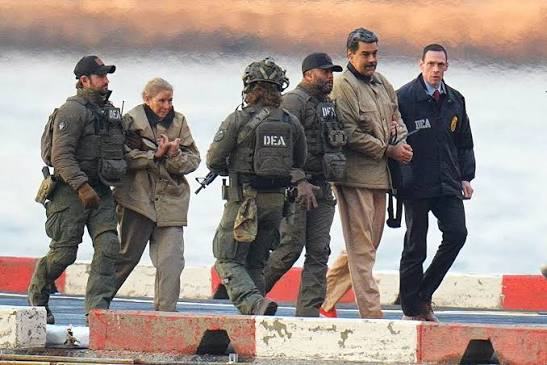
Discussion of the ongoing situation in Venezuela, along with its relevance to Colombia and Cuba, has seen the conflation of humanitarian nation-building, which has had a dismal track record in modern history, with the United States’ longstanding record of involvement in South America, a program that predates any postwar neoconservative doctrine. The operation to extract Maduro from Caracas, for the explicit procurement of oil and fealty from the remaining administration marks not an aberration, but a return to the classical interest-justified foreign intervention long enjoyed by American statesmen.
President Trump has been explicit that he plans to assert control over Venezuela’s $17.6 trillion crude oil reserve, having secured a 50 million barrel bounty thus far. State Secretary Rubio has intimated that future strikes on Caracas are contingent on the regime’s willingness to cooperate with America, in both the severing of economic ties to Russia, China, and Cuba, and the unbarring of native energy industry to US investment. Whereas prior presidents might cloak an influence operation in the garb of moral language, Trump’s justification is plainly strategic—that Venezuela has 18% of the world’s oil and America could benefit from it. Of course, casus belli doesn’t belie the entire reason for the intervention—which has more to do with knocking China out of the Western hemisphere—but it does mark a turn to tangibles. The anti-Chavista opposition leader, Machado, slated to take control of Venezuela in Maduro’s wake, has been dismissed by the Trump administration. The administration now intends to cooperate with the remaining Maduro government, headed by Delcy Rodríguez. If anything, this signifies a more restrained posture than—for example—Bush’s 2003 “shock and awe” invasion Baghdad ensuing in the ousting of Saddam Hussein. The latter, a war animated by the lofty ideological aim of bringing freedom, democracy, and liberalism to Stone Age jihadists, set in motion a two-decade entanglement that America still has yet to divest from. It is foreign in the strong sense, lying entirely outside America’s natural sphere of influence.
Venezuela is clearly distinct. Trump’s operation, which may or may not expand from this point forward, marks a return to a much older American geopolitical temperament, and cannot be so easily dismissed as a mere reprise of the Bush or Reagan eras only decades prior.
Comments 0

No comments yet. Be the first.