
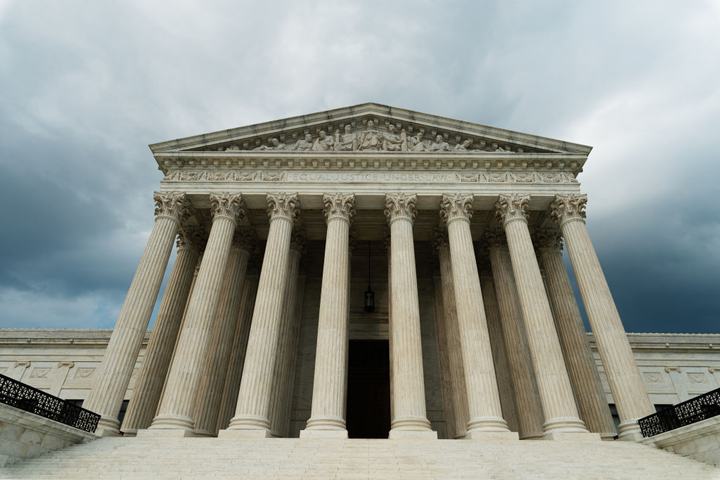
The Supreme Court has again reminded the country that, in the American system, the judiciary can halt executive action with the stroke of a pen—this time keeping in place a lower-court order blocking President Trump’s attempt to federalize and deploy National Guard forces to protect besieged immigration enforcement operations in and around Chicago.
To the Court’s defenders, this is the rule of law at work: the executive proposes, the judiciary disposes. To the Court’s critics, it is something else—an increasingly routine assertion that the most politically insulated branch holds the practical final word over national security judgments that are, by nature, time-sensitive and morally grave. The immediate legal dispute may turn on statutory parsing and evidentiary standards. But the deeper question is older and more elemental: when the ordinary legal order collides with what the executive believes to be an emergency, who is authorized to decide?
Carl Schmitt opens Political Theology with the line that polite constitutionalism loves to denounce—usually because it is too candid to ignore: “Sovereign is he who decides on the exception.” The point is not that the sovereign is morally good, or that the exception is always real. The point is analytic: every legal order is ultimately tested by the moment it cannot fully anticipate. When law is adequate, we congratulate ourselves that procedures worked. When law is inadequate, someone must decide anyway—because, in real time, indecision is also a decision, and often the most costly one.
That is why the Chicago episode matters beyond Chicago. Even if one thinks the administration’s legal theory is weak, or its factual claims overstated, the situation exposes a contradiction in modern liberal constitutionalism: we expect the executive to guarantee order, but we increasingly deny it the energy required to do so when conditions become politically contentious and legally novel.
Alexander Hamilton saw the matter with bracing clarity, writing in Federalist No. 70 that “Energy in the Executive is a leading character in the definition of good government.” And he did not defend energy as a kind of aesthetic preference for decisiveness. He defended it as a requirement of national survival and domestic stability—“essential,” as he wrote, to protecting the community and administering law. The very people who now appeal to “democracy” as a reason to distrust executive vigor forget that Hamilton framed executive unity and strength as the republican answer to chaos, faction, and the slow churn of collective bodies.
But the American tradition of emergency discretion is older than Hamilton and more philosophically explicit than his rhetoric of “energy.” John Locke, liberal though he was, defended what he called “prerogative,” defining it in his Second Treatise of Government as: “This power to act according to discretion, for the public good, without the prescription of the law, and sometimes even against it.”
Locke’s argument is not that law is worthless. It is that law is general, and life is particular; legislators are intermittent, emergencies are not; and “it is impossible to foresee” every contingency. In short: no written code can substitute for responsible judgment when the facts outrun the forms.This is not merely a modern, secular insight. The classical and Christian traditions contain their own doctrines of equity and necessity.
Cicero’s maxim in De Legibus is famous because it is blunt: “Salus populi suprema lex esto.” Whatever one thinks of modern invocations, the thought is plain: the life and safety of the political community impose a claim that ordinary legality cannot always absorb without remainder.
Aquinas, too, recognized that there are moments when fidelity to the letter of the law becomes a betrayal of its spirit. In his treatment of epikeia (equity) in the Summa Theologiæ, he warns: “To follow the letter of the law when it ought not to be followed is sinful.” And he offers an even sharper formulation, quoting the legal tradition: “Without doubt he transgresses the law who by adhering to the letter… strives to defeat the intention of the lawgiver.” The point is not “anything goes.” The point is that the higher end of law—the common good—can be thwarted by a mechanical insistence on procedure when conditions become exceptional.
Now, the moment one speaks this way in the United States, the objection arrives like clockwork: “Are you saying the President can ignore the courts?” That question smuggles in an assumption: that the Court is the only legitimate interpreter of the Constitution, and that the executive’s oath is, in practice, an oath to comply with whatever the judiciary says the Constitution requires.
But that is not the only American theory. Thomas Jefferson, writing to jurist Spencer Roane in September 1819, stated the coordinate-branch view with unmistakable directness: “each of the three departments has equally the right to decide for itself what is it’s duty under the constitution.” That is departmentalism in a sentence: the branches are not mere clerks for judicial decrees; each bears independent responsibility to the Constitution as it understands it.
Andrew Jackson echoed the same principle in his Bank Veto Message, insisting: “The opinion of the judges has no more authority over Congress than the opinion of Congress has over the judges, and on that point the President is independent of both.” Jackson’s language is often condemned as populist swagger. But its underlying logic is constitutional: if the President is a co-equal branch with a separate oath, then his interpretive duty cannot be reduced to passive obedience whenever the judiciary speaks.
Even Abraham Lincoln warned of what happens when judicial decisions harden into political finality. In his First Inaugural Address, he wrote: “if the policy of the Government upon vital questions affecting the whole people is to be irrevocably fixed by decisions of the Supreme Court… the people will have ceased to be their own rulers.” Lincoln’s point was not that courts are illegitimate. He explicitly added that this view is “no… assault upon the court or the judges.”
The point was that a republic cannot outsource its highest political judgments to a tribunal without hollowing out self-government. Put those threads together—Cicero’s salus populi, Aquinas’ equity, Locke’s prerogative, Hamilton’s executive energy, Jefferson’s coordinate construction, Jackson’s independence, Lincoln’s warning—and you get a tradition that modern progressives and libertarians alike often deny exists: an argument that the executive office is not merely an administrative convenience but a constitutional instrument designed for decision under pressure. So what does that imply for the case at hand? First, it implies that the Court’s emergency posture is not neutral. By keeping the deployment blocked while litigation drags on, the judiciary effectively chooses a policy: it prefers the risk of executive incapacity to the risk of executive overreach. That may be defensible in some cases. But it should be recognized for what it is: not a purely legal determination, but a choice about which dangers the regime is willing to tolerate.
Second, it implies that the Right can, if it for reason chooses to, resist a false binary. The choice is not necessarily between judicial supremacy and a Cæsar. The older constitutional imagination—ironically closer to the Founding than today’s lawyerly pieties—assumed that emergencies are inevitable, that executive decision is necessary, and that legitimacy flows not from the pretense that exceptions do not exist, but from making exceptions politically accountable.
Indeed, Hamilton paired energy with responsibility. He wrote that republican “safety” depends upon “a due dependence on the people” and “a due responsibility.” Executive decisiveness is not justified because executives are saints; it is justified because the office can be held responsible—through elections, through appropriations, through oversight, through impeachment when necessary. Courts can restrain abuses, but courts cannot substitute for the political branch that must actually bear the consequences of disorder.
Third—and this is where the Schmittian diagnosis becomes unavoidable—liberal regimes often try to domesticate the exception by proceduralizing it. But Schmitt’s warning is that when a system refuses to name the exception, the exception arrives all the same, and sovereignty reappears in disguised form. If the executive is denied the capacity to decide, someone else decides, be it bureaucracies, courts, or vigilantes.
If the Court wants to second-guess emergency deployments, it should do so with humility about its own institutional limitations, and with respect for the elected branch charged with “dispatch requisite to execution.” If Congress wants fewer constitutional crises of this kind, it should legislate clearly rather than hiding behind ambiguous delegations and then outsourcing the controversy to judges.
The Chicago dispute will be litigated in briefs and orders. But the constitutional question will be answered elsewhere: in whether Americans still believe that self-government means the people, through politics, can authorize decisive action for the common good—or whether “vital questions affecting the whole people” will be “irrevocably fixed” by the judiciary alone.
No comments yet. Be the first.