
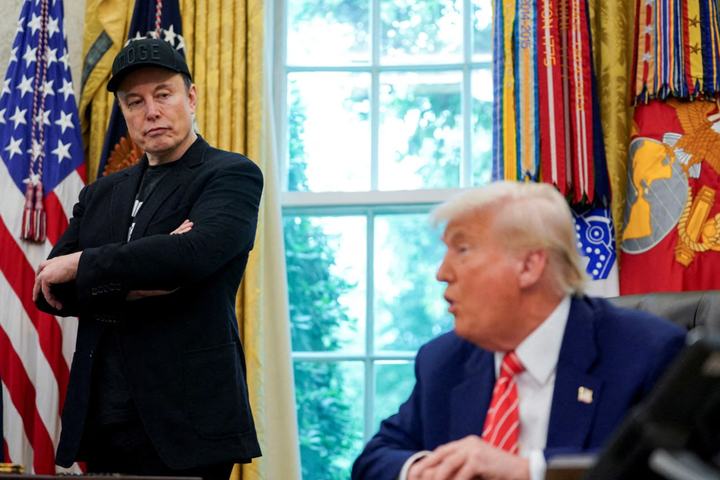
Former senior adviser Elon Musk’s departure from the White House seems ostensibly on good terms — Musk thanked the President for the opportunity and Trump-adjacent influences warmly received his resignation. However, this amiable veneer did not reflect reality, for (as Musk would later enumerate) there was intense disagreement from Musk upon the President’s agenda, specifically regarding the budget reconciliation “Big Beautiful Bill” (BBB) that had passed in the House just a week prior. The bill, estimated to increase the monstrous deficit by over $2 trillion over 10 years, stood completely in opposition to Musk’s goal of reducing government spending in DOGE. In response to its passage — and subsequent Senate vote — Musk directly broke from the President, calling the bill a “disgusting abomination" and urging GOP Senators to vote against it.The fledgling feud escalated within the next few days, as attacks became increasingly personal (in Trump-like fashion), eventually culminating in the now-deleted infamous accusation of Trump’s affiliation with Jeffrey Epstein. Seemingly, any sentiment of goodwill — or potential reconciliation between the two — was decimated by the post, perhaps intentionally so. Despite this weighty accusation, the icy relations seemed to warm just three days later as Musk reposted Trump’s comments on the Los Angeles Riots, in a corollary of his criticism of mayor Karen Bass. Two days afterward, Musk stated his regret for his posts about Trump on X, following his personal apology over the phone.Musk’s split and subsequent accusations, though masked in scandal, are spurred by his commitment to government cost-cutting at the expense of all else. Following the gargantuan spending and cash injections into the recovering Biden economy, reduced government spending became the predominant reason for Musk’s support of Trump in 2024. However the BBB — specifically in permanentizing the tax cuts of the first Trump admin while increasing spending on the military and immigration enforcement — is intrinsically opposed to Musk’s goal of government efficiency (in this case through reducing government spending).Obviously, maintaining tax cuts while increasing government spending is bound to balloon the deficit — but that is a cost Trump is willing to take for his domestic agenda. Musk, whose telos was (and still is) reducing that deficit, ideologically has great objections to such a bill. Initially, their priorities seemed aligned, as Trump’s domestic agenda had not called for increased spending as the BBB did.Trump and Musk, though not as in lockstep as prior to the BBB, to all appearances have reconciled, in part due to the efforts of James Fishback. Fishback held political capital as both an ally of the Tesla CEO and Trump; the former at his role in the DOGE dividend checks. His public call for an apology from Musk alongside explicit support for the president alienated Musk and put pressure on the Tesla CEO to reconcile with Trump.Though the two have reconciled personally, Musk’s influence in the Trump administration has left with his exit. Their alliance has ended as a result of the fundamental difference in ideology, despite the veneer of scandal which likely resulted from Trump’s personal attacks on Musk, as the latter returned fire (if too haphazardly). The president’s executive agenda of mass deportations and corporate tax cuts trumped his desire for gutting government spending, abandoning Musk’s sole focus of reducing deficits.The former senior adviser is hellbent on efficiency not only due to his personal philosophy, but more so as regards his own career. He views the US government as a business primarily, one which has potential to increase his other ventures. His businesses have received nearly $40 billion in government contracts, obviously incentivizing him to increase his role in that same government playing a crucial role for his firms (most notably SpaceX). The president’s threat to cut these government contracts during the apex of the feud likely pressured Musk to make amends alongside Fishback’s efforts.Musk is the key representative of the “Tech Right”, a burgeoning sector of the right-wing seeking to implement technocratic goals of low regulation and cheap labor, notably exhibited in Musk's Twitter spat over H-1B visas in the waning hours of 2024. Undergoing 4 years of the Biden administration’s enormous spending, alongside the epoch of the DEI craze accompanying those years, Musk pivoted from his previous techno-liberalism evident in his voting records to the GOP and Donald Trump, who are much more hospitable to reducing deficits. It was thus that his vote for Trump — and outsized influence in his campaign & presidency — occurred.But with the advent of the Big Beautiful Bill, a key part of the president’s agenda that nevertheless would inflate the deficit in the trillions, Musk’s long-held (and somewhat milquetoast) quest to gut spending was forced to meet with a Trump whose similarly broad initial agenda had gone lukewarm in execution, particularly in deportations and tariffs. The BBB, containing budget increases for deportations as well as maintaining the 2017 tax cuts, are crucial to the president’s domestic agenda — and it is thus that his support is near unwavering. Musk is diametrically opposed to such a bill, as are those alongside him (namely budget hawks such as Thomas Massie and Rand Paul).Similarly, his technocratic philosophy (and status as wealthy businessman) predisposes him to be against any form of trade restriction, for which Trump has been prone to enact — or attempt to. Initially, Musk’s opposition was muted in submission to the executive’s decisions, as he noted that Tesla was uniquely spared from the Liberation Day tariffs due to its ‘localized supply chains’. However, his departure released Musk from the impetus to stand behind the president’s policies, in which he revealed his belief that his tariffs would ignite a US recession.Trump, though entrepreneurial in his own right, has a far broader agenda than Musk for his vision of the government. It is obvious that a large-scale mass deportation operation — if that is his true intention — would indeed necessitate more spending for immigration enforcement, a key part of the BBB. His tariff policy potentially could bring in revenue, however would need to generate obscene amounts to offset the initial economic pain that comes with tariff policy in the modern age that is not likely to occur. If combined with subsidies for a holistic industrial policy (such as the CHIPS Act) then that potential revenue would be further diminished. What these explicate is Trump’s willingness to utilize the budgetary power of the government to deliver agenda goals, anathema to budget hawks such as Musk or Massie. Though Trump has indeed promised to reduce spending, his philosophy is willing to concede that in favor of his other policies — frustrating Musk’s seemingly only political objective.This crack in the MAGA coalition is emblematic of the larger issue of the ‘big tent’ in the GOP, a term most associated with the bygone days of Romney that nevertheless reveal themselves 13 years later. The big tent strategy is arguably effective in winning elections, but at some point if left unchecked leads to executive gridlock emerging from differing priorities and necessary opportunity cost. This dynamic need not be an issue if Trump had the political will to enact such changes; however, his agenda has proven increasingly unpopular (especially his tariff strategy) and that political will is incredibly difficult to muster with a two-seat majority in the House.If the ‘big tent’ strategy were to be a successful form of governance, especially under a united Republican trifecta, then concessions would have to be made from all parties involved — be it budget hawks or immigration hardliners. The president’s ostensible reputation as the latter should have informed Musk as to his goals — especially mass deportations, which would require an increase in government spending — and it is thus that the split is not surprising. So long as the GOP, and even Trumpism, relies not on ideological loyalty and instead on those who have to most to give Trump in terms of political capital, then it mustn't be expected that the Trump’s goals of mass deportations and other policies which are not cohesive to the agenda of the political capitalists will follow through. Indeed, those policies will remain at the sideline and both parties will be frustrated. Musk’s project of a wholly transformed federal government has now faded, and the president’s access to his political capital has gone similarly.What people such as Charlie Kirk attempt to conceal at every iteration of a split in MAGA — be it the legal immigration debacle, the Musk split, and more recently Trump’s bombing of Iran — is that Trumpism is not a united front wrestling the reigns of America from the Democrats (or globalists, communists, socialists, etc.). MAGA is fundamentally a big tent, perhaps the largest in modern political history. This has made the movement extremely effective in electioneering, but impotized it when it comes to actual governance. Trump losing Musk as an ally was inevitable, and many saw the writing on the wall far before the schism. The entire debacle illustrates the necessity to view Trump as solely a stepping stone towards more nationalistic politics. MAGA is unstable, susceptible to influence by nefarious actors (some argue already compromised) and insolvent. Arguably, it was Musk’s efforts that propelled Trump over Harris to win his second term, which he believes, and his departure not even a year into his explicit support for Trump shows the instability of the big tent in governance. Their reconciliation has indeed curbed the worst possibilities of the split for Trump’s political stance, but it is not difficult to conjure a scenario where Musk’s money and allies could have been used in opposition to Trump’s agenda — specifically with immigration policy and the tariff regime.As Trump is de facto a lame duck president, he has essentially been on his way out since the start of his second term barring anything extraordinary. The GOP’s most obvious successor to MAGA is of course JD Vance, whose allegiance to Trumpism (the restrictionist, isolationist, and protectionist form at least) is extremely questionable. The president’s key ally of Musk demonstrates perhaps the largest inevitable split of two men with vastly different priorities, and indeed large disagreement over matterful issues — especially for nationalists. One need not look further than Musk’s aforementioned vigilance for legal immigration and disdain for tariffs to see this disagreement. Only Trump could have maintained such an alliance for this long as a negotiator, and yet he could not prevent the inevitable.Musk was indeed a key resource for the president, whose presence fostered a symbiotic relationship potentially increasing the influence of Trump on Republican politics, a potential boon for nationalists in primarying “RINOs” often blamed for shortfalls in Trump’s first and second terms. However, it was never meant to last, and nationalists pragmatically — often axiomatically to their demerit — believe in Trump’s ability to carry out their goals. His movement is insolvent, which must evolve past him and his willingness to bring those antithetical to their goals such as Musk so close to him in his administration. Musk getting his way, from high legal immigration and low tariffs, would represent that exact portion of the GOP that Trump is thought to have decimated in his first campaign. What people like Musk illustrate is that there will always be a demand for ideas incompatible with nationalism, and Trump’s alliance with people like them for politically lucrative opportunities will only restrain hope for policies conducive to that agenda. If anything can be learned from Musk and Trump’s split it is that enduring alliances cannot rest on the facile quicksand of political capital; they must be built on lasting commitments.
General · Opinion ·
A Retrospective on the Musk-Trump Split
Musk and Trump’s clash demonstrate the issues of the ‘big tent’, and proves MAGA isn’t here to stay.
No comments yet. Be the first.