
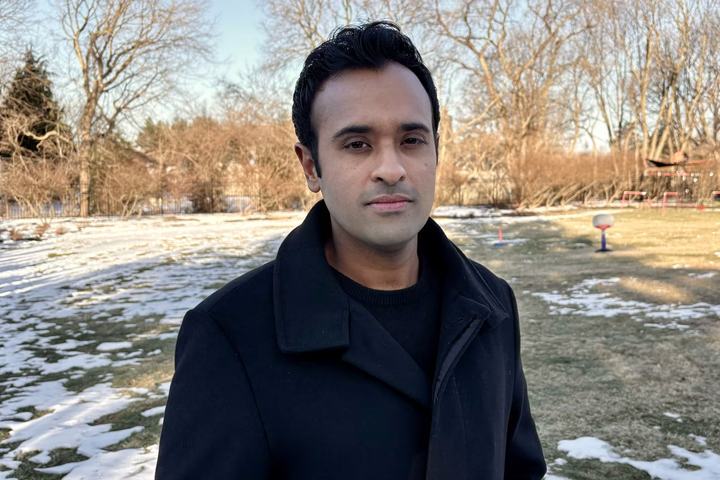
Vivek Ramaswamy’s developed a weird yuletide tradition. Every Christmas, it seems, he mounts his sleigh and slides down your feed — not to deliver gifts, but to tell you what counts as an American. A year ago at this time, it was “anyone smart enough to take a job from a middle class earner.” That take alone sufficed to drum him out of Trumpworld within a month — but he’s undeterred. A year later — just in time to lose us another governorship — in an op-ed for the New York Times , he’s back with an even broader definition: "Anybody who likes America or American-sounding stuff.'
His definition of an American, then, is the same as anybody else’s: “Me.”
Takes like this are a reminder that the left still makes the rules after all these years. Recall how they’ve spent a century telling us that everything is a state of mind — gender, criminality, race, marriage, etc. It worked: the Republican Party’s last hope in Ohio thinks that being an American is a state of mind too, namely the state of “believ[ing] in the rule of law, in the freedom of conscience… in colorblind meritocracy.” Or, as that translates more practically: any human being who says all that stuff and smiles. That can’t be right. To have any staying power, nationality must be rooted in specific immutable qualities that do not change in the eye of the beholder. And we’re already being pushed around and pickpocketed by nations who figured this out centuries ago.
Now, Vivek doesn’t think his qualifications for American-hood are vague. They’re not “scalar,” he says; each is a “binary.” Well, let’s look at these mathematical cutoffs of his. First, you have to believe in the “freedom of conscience and the freedom of expression.” That’s a real on/off switch, isn’t it? Of course, the number of Americans who believe you should be able to express any sentiment at any given time is exactly zero Americans. And as for conscience? Good heavens — find me any serial murderer and I’ll lay you odds his conscience told him to do it. “Liberty” is not a thing one can believe in wholesale; my liberty to live infringes on your liberty to gun me down and vice versa. So, criterion one is just a bumper sticker simulacrum for “nice guy.” Noted.
Next up: you believe in “the rule of law.” This is a strange term, as it has nothing to do with what the law is. Here’s one of the biggest rule of law guys to ever live: Adolf Eichmann — the law said the trains had to run on time, and boy did they ever. It’s liberalism’s dirty secret: the rule of law means the rule of whatever the law happens to be that day. And who makes the laws in America? Well, what with the democracy and all, the Americans. Now there’s a premise: you’re an American if you believe… what the Americans believe. Upshot: when Ilhan Omar and the gang install Sharia Law in Minnesota this decade, the true “American” is now the ardent Sharia follower — or at least the guy who rolls over and submits to it.
The third barely warrants mentioning: “colorblind meritocracy.” I mean… based. Guess Cornell West’s not an American. Sorry, liberal. But let’s hit that fourth one: belief in the “U.S. Constitution.” Believe in it how? Believe that it’s good? Lots of Americans don’t. And let’s be honest, we don’t even know what the thing says until after we act — when the Supreme Court is so kind, after ten years and two appeals, to tell us. So, it can’t be whether the Constitution stands for the right things; we don’t know what it stands for and I don’t see anybody deporting Laurence Tribe. So we’re left with this: a belief that, whatever the Constitution stands for, you have to follow it. And just like that, we’re right back in the rule of law hole.
There’s only one criterion on Vivek’s list that sounds remotely serious at all: “if you are a citizen who swears allegiance to our nation.” That at least precludes literal spies, and adds to a list heretofore comprised of be nice and do what the government — some government, whoever may be in it — tells you. But it’s unprovable. Really, all of these criteria are — how do you know a guy fits the bill? Do we have a field team monitoring how he responds to authority in Kuala Lumpur? Does he just have to raise his right hand, nod his head, and seem generally nonthreatening? If so, Vivek’s Americanism test is really just “did the government let you in?” And he even admits this explicitly: “if you wait your turn and obtain citizenship, you are every bit as American as a Mayflower descendant.” Translation: if Joe Biden fasttracked five thousand of you into the country last year from the fourth world, you’re a heritage American — as long as you’re kinda into freedom.
This is another leftist mindworm, by the way: that the state decides what reality is, such that all our problems can be fixed procedurally. And the right buys it hook, line and sinker. What was the problem with Roe v. Wade? Not that abortions were murder — just that we weren’t letting the states decide if they were murder. And what’s the problem with immigration? Not that we have imported the third world wholesale into residential neighborhoods; no, it’s that some of them didn’t sign the magic paper.'
So much for this year’s cathartic drubbing of Vivek Ramaswamy. But that’s the easy part; it’s obvious that you can’t construct a lasting group around evolving platitudes. The dangerous part is in trying to enumerate specific Americanizing criteria. And the reason Vivek’s article sucks is because he knows full well you’re not allowed to put that kind of stuff in print; he’s not stupid, he’s just running. The list of characteristics more immutable than saying “I like America, I promise!” is, to be sure, a fraught one — and let’s be honest, it probably doesn’t resemble a guy named Vivek Ramaswamy.
So let’s just get the big one out of the way: a racial basis for nationality. I mean, look… that’s racist. Racist, of course, unless you’re China. You might have noticed that Chinese people are generally Chinese — ethnically I mean, and good luck becoming a citizen over there if your name’s Pat O’Reilly. China has endured for five thousand years precisely because it is one closely guarded group. Notice I didn’t say the Chinese government — there have been several of those. The group — the Chinese people — have endured as one culture for five thousand years. And that’s because group, not government, is the relevant statebuilding unit. Believe it or not, governments do not dictate what constitutes a people; a people, predetermined in nature, dictates what constitutes its government.
Maybe China’s a bad example — not much of an ally, after all. So let’s turn to our greatest ally on the face of the earth: the State of Israel. You might notice that Israelis are generally Jewish. And that’s a group that doesn’t play around when it comes to inclusion; indeed, they trace the matrilineal line to establish a clear, eyewitness chain of genetic custody. They’re not evangelizing; you can join, but it’s a more prolonged process than amnesty or asylum. Cultural assimilation must be total — and, vitally, it’s a prerequisite to joining the group. Since allegations of racism and antisemitism are still the WMDs with which careerists wage warfare, I must preface: none of this is to speak ill of Chinese people or Jewish people. Rather, it’s a compliment: they understand how cultures work and, lo and behold, they’re successful. And whereas heartland Americans struggle to make ends meet in their own country, Chinese and Jewish people manage to form successful homogeneities across borders that invariably accrue to the homeland’s benefit.
It’s not some vast conspiracy; these are families. They pool capital; they preserve opportunities. And they advocate for themselves. What’s often known as “racism” or “antisemitism” in these contexts is really almost a sense of yearning — of fragmented cultures in America’s heartland with no accumulated capital watching as all the other groups are allowed to be groups. They’re allowed to organize around objectivity. You’re not.
But race is just one component — let’s go back to law. If it’s not enough to believe in “the rule of law,” the natural followup asks “what law should rule?” That’s a question of morality — which has two components, religious and cultural. A man’s religion is the component with the most direct bearing on morality, as it embodies the set of moral precepts he actually holds. But, like “believing in freedom of conscience,” it’s hidden from view; the full measure of a man’s character is not a box he can check on an immigration form, however many may treat it as such. This is why the culture he hails from is a vital metric. Culture is, in some sense, the general religion of a people; while individuals may live secret lives, group behaviors form a general trendline useful for making broad strokes determinations. This is the nuance that common appeals to “heritage” miss; it’s not an effective barometer if you’re looking for generalities like “do they seem nice?” We need to get specific. What religion do they generally follow? What are their social dynamics — family structures, gender delineations, work ethic. Do there tend to be a lot of wars over there? What’s the crime situation like? This stuff matters.
To be sure, this is stereotyping — and such an approach, while accurate across groups, will invariably squeeze out people with, at minimum, American morals. But we used to believe — as China, Israel, and countless other nations still do — that cultural cohesion was worth the price of those unfair omissions. Before 1965, American immigration came from countries which already fit into our cultural context. And I’ll be frank about what that means: largely European countries. Countries that celebrate, I dunno, Christmas — a specific kind of holiday marked by familial and community gathering, and rooted in a specific, Christian, sacred experience. Countries that weren’t war-torn; countries that behaved like ours or, at minimum, strove to.
I won’t pretend the “who is an American” question is clean-cut. It’s not just white people — I’m aware that if your ancestors came by boat, it wasn’t always the Mayflower and that matters. And it’s not just “not brown people” — there’s nuance to this. But it should strike you as odd that America is one of the few nations in history not synonymous with a specific ethnicity and culture. It’s only recently started to push the boundaries of that already perilous foundation — during the single most prosperous and unrepresentative period in the history of the world — and has declared presumptively, after hardly a generation has passed, that the experiment worked. So, it may be the case that our government has spent the last fifty years deciding that large, random swathes of the developing world were suddenly “Americans” — and that the real answer to Vivek’s question, today, is “whatever the census says.” But, as harder times set in, the questions going forward are who can be an American. And who should be an American. And, more harshly, if anyone should stop being an American.
These questions require us to isolate a slate of very specific American attributes. Doing so is tough. It requires you to make concrete statements that are going to hurt feelings — and, bluntly, they may well be Vivek Ramaswamy’s feelings. But nationality is not a blithe business and serious nations have never treated it as such. Next Christmas when he’s running for mayor of Cincinnati, I hope our jolly friend keeps that in mind — and that his mouth shrinks three sizes that day.
No comments yet. Be the first.