
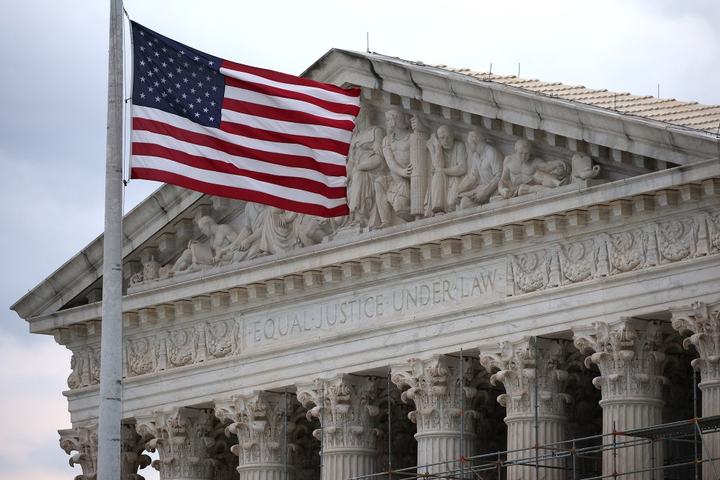
Birthright citizenship is the most pressing political debate today. Much is at stake: the duties of citizenship, control of our nation, and what it means to be an American. Unfortunately, many are under the delusion that our Constitution requires birthright citizenship. But that is not true: birthright citizenship does not accord with the text, nor record of the Constitution, nor the history of the nation that birthed it. If we are to regain a conception of our nation, we must repudiate this idea.
I. Background
To understand this debate, we must understand the justification for birthright citizenship. Everyone agrees that the main—and only—justification for birthright citizenship comes from the Fourteenth Amendment. Relevantly, it states, “All persons born or naturalized in the United States, and subject to the jurisdiction thereof, are citizens of the United States and of the State wherein they reside.” Everyone also agrees that the main thrust behind this amendment was to ensure that freed blacks were made full citizens of the United States and the state where they reside. (See Slaughter-House Cases, 83 U.S. 36 (1872)).
However, beyond that conclusion, there were many questions about to whom this amendment applied. At first, the Supreme Court appeared to interpret the amendment to not grant birthright citizenship. First, in the Slaughter-House Cases, the Supreme Court ruled that the Fourteenth Amendment was “intended to exclude from its operation children of ministers, consuls, and citizens or subjects of foreign states born within the United States.” Id. at 73.
Then, in Elk v. Wilkins (112 U.S. 94 (1884)) the Supreme Court held that an Indian who “was born in the United States” was not a citizen of the United States under the Fourteenth Amendment. (Id. at 99). The Court reasoned that “subject to the jurisdiction thereof” did not mean “merely subject in some respect or degree to the jurisdiction of the United States, but completely subject to their political jurisdiction, and owing them direct and immediate allegiance.” (Id. at 102). (emphasis added). It further stated the principle that “no one can become a citizen of a nation without its consent.” (Id. at 103).
Finally, as a part of the “insular cases” which dealt with newly acquired U.S. territories, the Supreme Court held that those born in these territories, although they may be under the laws of the United States and even “subject to the jurisdiction thereof,” are not born in the United States and therefore are not citizens. (Downes v. Bidwell, 182 U.S. 244, 278 (1901)). The Supreme Court would later go a step further, distinguishing between those territories which are “incorporated into the United States as a body politic” and those not, while still saying that these territories are “subject in all respects to [the United States’] jurisdiction.” (Dorr v. United States, 195 U.S. 138, 143, 155 (1904)).
Then, in a reversal of this trend, the Supreme Court declared its opinion in U.S. v. Wong Kim Ark. (169 U.S. 649 (1898)). That case held that those born in the United States are automatically citizens of the United States. (Id. at 693). Taking on the words “subject to the jurisdiction thereof,” they reasoned that the United States has “exclusive and absolute” jurisdiction “within its own territory,” and therefore anybody “born” within the territory of the United States is also “subject to the jurisdiction” of the United States. (Id. at 686). The only people who could be born in the United States and not “subject to the jurisdiction thereof” are a very narrow class of people, including ambassadors, certain Indian tribes, and hostile forces occupying American soil (conveniently those groups precluded by prior caselaw). (Id. at 681). With this reasoning, the Supreme Court supposedly enshrined birthright citizenship.
II. Meaning of “Subject to the Jurisdiction Thereof”
The Supreme Court’s reading of “subject to the jurisdiction thereof” is wrong, and in any event, its holding in Wong Kim Ark doesn't necessitate birthright citizenship. The whole argument in Wong Kim Ark hinges on a particular reading which equates “subject to the jurisdiction thereof” with “within its own territory.” However, the Court’s reading suffers from several flaws.
First, it is likely not the historical meaning of “subject to the jurisdiction thereof.” There is much evidence instead that that phrase was meant to restrict citizenship to those people who were lawful residents in the United States. (See, e.g., Amy Swearer, Subject to the (Complete) Jurisdiction Thereof: Salvaging the Original Meaning of the Citizenship Clause, 24 Tex. Rev. L. & Pol. 135, 145 (2019)). This reading coheres with the historical record—at the time, contemporary debates and remarks about citizenship reflect that the clause was not meant to extend to those not given lawful residence. (See Cong. Globe, 39th Cong., 1st Sess. 2768, 2769 (Senator William P. Fessenden objecting to an early draft of the Fourteenth Amendment which granted citizenship to all “persons born in the United States” on the grounds that it would have granted citizenship to “a person [who] is born here of parents from abroad temporarily in this country.”); Letter from Sen. Lyman Trumbull to President Andrew Johnson, reprinted in Andrew Johnson Papers, Reel 45, Manuscript Div. Library of Congress(stating that the legislation which was enshrined in the Fourteenth Amendment was meant to give citizenship to people “born of parents domiciled in the United States”); Cong. Globe, 35th Cong., 1st Sess. 210 (1858) (Representative Philemon Bliss stating that children of “temporary sojourners” were an “exception” to the Fourteenth Amendment); Cong. Globe, 35th Cong., 2d Sess. 984 (1859) (Representative John Bingham stating that the citizens of the United States are “all free persons born and domiciled within the United States) (emphasis added)).
Second, the Supreme Court doesn’t even adhere to this reading. The Supreme Court still maintains that those people who are born in the “territories” of the United States are not necessarily automatically American citizens. As noted above,the Supreme Court ruled that those born in the territories of the United States are not automatically American citizens. This is still good law: today, everyone born on American Samoa is not an American citizen, but merely an “American national.” The Supreme Court has repeatedly refused to reconsider its opinion on this. (See Fitisemanu v. United States, 143 S. Ct. 362 (2022); Tuaua v. United States, 579 U.S. 902 (2016)). It is hard to say that the people in these territories are not a “part of the United States,” as the insular cases held, since this holding was based on now-out-of-fashion views about certain territories. (See, e.g., Lisa Maria Perez, Citizenship Denied: The Insular Cases and the Fourteenth Amendment, 94 Va. L. Rev. 1029, 1060 (2008) (student note)). But it is equally as difficult to say that they are not “subject to the jurisdiction” of the United States as well.
To solve these issues, but still maintain birthright citizenship, some argue that “subject to the jurisdiction thereof” means “answerable to our country’s laws.” (See Trump v. Washington, Brief for Respondents No. 25-364 (Oct. 29, 2025)). However, the argument is impossible to square with the exceptions to the “subject to the jurisdiction thereof:” ambassadors, certain Indians, and even hostile aliens may be “answerable to our country’s laws” depending on their actions within the territories of the United States. And this counter doesn’t even defeat the examples above: no one disputes that American Samoans are not answerable to the laws of the United States.
The key to understanding the amendment is the understanding that jurisdiction cannot exist without the will of the sovereign. Certainly, a sovereign cannot be forced to have jurisdiction over another; then it would not be sovereign. If the sovereign’s consent is needed to support jurisdiction, then only those who the sovereign consents to enter the country—that it, to whom the sovereign consents to extend jurisdiction—can truly be said to be under the jurisdiction of the United States. In other words, only those lawfully admitted in the United States are “subject to the jurisdiction” of the United States, and therefore citizens.
The way to distinguish the case of illegal aliens and that of Wong Kim Ark is the word “domicile,” used dozens of times to describe the parents of Wong Kim Ark. (See, e.g., Wong Kim Ark, 169 U.S. at 652 (“domiciled residents”)). A domicile is a specific legal term, not just referencing a place where someone lives; rather, it represents a legal relationship with the sovereign of the territory in which one intends to reside. (Black’s Law Dictionary, “Domicile.”) Therefore, the parents of Wong Kim Ark were defined as domiciled, and thus having a legal relationship with the United States. The same cannot be said of illegal aliens. Therefore, illegal aliens are not subject to the jurisdiction of the United States, and so their children are not automatically citizens under the Fourteenth Amendment.
III. Confusion of Citizenship
As evident, birthright citizenship has no place in our Constitution. And yet how did so many come to hold sincerely that the right to citizenship ought to be extended to all people who are born in the territory of the United States? Part of the answer is certainly partisan; however, part of it has to do with an idea that, without citizenship, illegal aliens and others who are living in the United States will not have the same rights as American citizens. That is wrong—the Fourteenth Amendment guarantees due process and equal protection to “all persons,” not all citizens.
What most of the debate confuses is the exact nature of “citizenship.” Citizenship is not the right to vote. (See Minor v. Happersett, 21 Wall. 162, 168 (1875)). In fact, historically, citizenship had nothing to do with rights. Instead, to be a citizen was to understand that one owes “direct and immediate allegiance” to the United States. (Elk v. Wilkins, 112 U.S. 94, 102 (1884)). Therefore, citizenship is not a thing which gives us access to rights: rather it is a duty, laid upon those who have an obligation to the nation.
Birthright citizenship undermines this view. If everyone is given citizenship simply for the coincidental fact of having been born in the United States, then citizenship is not defined by those who owe allegiance to the nation. Rather, citizenship must become something which confers access; for we cannot seriously demand obligations of those foreigners who were born in the United States and now live abroad. Instead, we can only give them the benefits of citizenship, and therefore citizenship must become something which offers benefits to all, while obliging nothing in return. This transformation of citizenship, from something reciprocal to asymmetric, marks the cheapening of what it means to be American. It represents the height of optionality that even our obligations to our nation have become something which we can opt out of.
Even without birth tourism, birthright citizenship undermines the true conception of citizenship. Citizenship is not any ordinary duty; rather, it is an obligation requiring “direct and immediate allegiance.” This duty does not arise out of any ordinary interaction, in the way that a business obligation may arise; rather, this duty comes from having a relationship with the nation, one that either stems from one’s heritage or that arises from the nation’s hospitality. An illegal alien cannot assume such a duty; inherently, they reject relationship with a nation by rejecting its laws, and seek to occupy the territory as an invader rather than as a guest. Extending citizenship to them is rewarding transgression and undermines the relationship which provides the deep bonds of citizenship.
But birthright citizenship presents an even more insidious factor, and that is that it undermines the conception of what it means to be an American, especially when taken with the right to vote. If being an American is synonymous with having US citizenship, then being an American means nothing more than having been born on the right side of a geographic boundary. On the flip side, if being American means something more than that, then Americans must confront that they have lost autonomy over the governance of their own nation, which has foolishly permitted non-Americans to influence the outcome of American elections. Any legitimate ruling on birthright citizens must acknowledge the latter.
It is of utmost importance that the Supreme Court reject birthright citizenship. We must pray for the good wisdom of those in that most high court; for if they decide otherwise, only a miracle could save our nation.
No comments yet. Be the first.